
Will 5G Actually Boost the Economy? Here’s What We Know in 2026
The 5G rollout economic boost is one of the most debated topics in tech and policy right now — and for good reason.
Here’s a quick snapshot of what the evidence says:
| Question | Short Answer |
|---|---|
| How much could 5G add to US GDP? | $1.4 to $1.7 trillion over the next decade |
| How many jobs could it create? | 3.8 to 4.6 million in the US alone |
| Has that growth shown up in data yet? | Not clearly — empirical studies show mixed results so far |
| Which industries benefit most? | Healthcare, smart utilities, and manufacturing lead the way |
| What’s the biggest barrier right now? | Lack of mid-band spectrum and slow infrastructure rollout |
The promises are enormous. Industry reports from firms like BCG, Accenture, and PwC paint a picture of a technology that could reshape the entire US economy — creating millions of jobs and unlocking trillions in output. But independent researchers have pushed back hard, finding little measurable economic impact in county-level data so far.
So what’s actually happening? Is 5G a genuine economic engine, or is it still more hype than reality?
That’s exactly what this guide breaks down — in plain language, with real data, and without the marketing spin.
I’m Faisal S. Chughtai, founder of ActiveX, where I work at the intersection of digital technology, infrastructure, and business growth — areas that put the 5G rollout economic boost squarely in my wheelhouse. With experience spanning app development, digital marketing, and enterprise tech strategy, I’ll help you cut through the noise and understand what 5G’s economic story really looks like heading into the second half of this decade.
Key 5G rollout economic boost vocabulary:
- e-commerce sales growth data
- renewable energy investment boom
- emerging markets growth forecast
The Trillion-Dollar Promise: 5G Rollout Economic Boost Projections
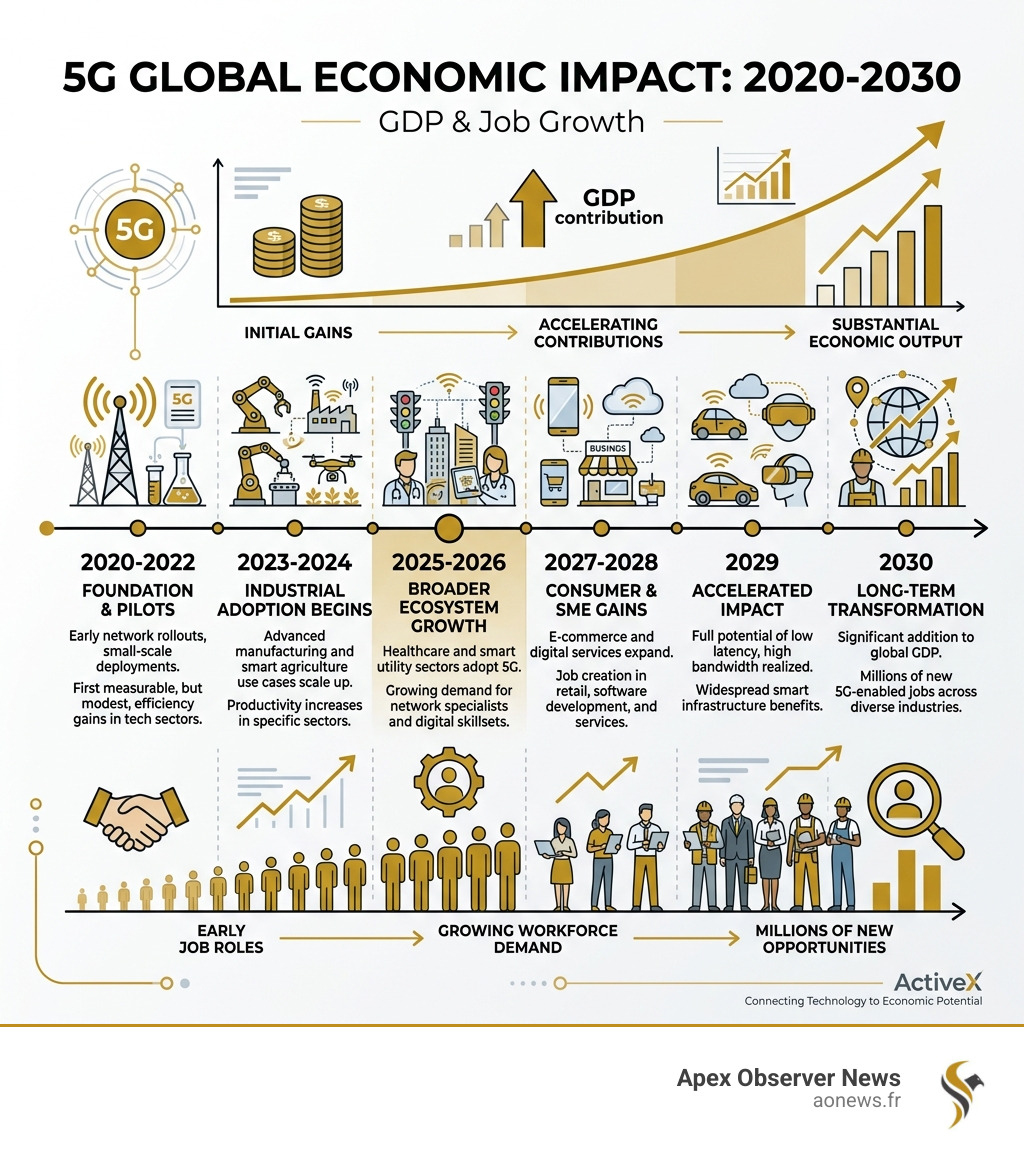
As we navigate through April 2026, the discussion around the 5G rollout economic boost remains centered on massive numbers that sound almost like science fiction. According to major industry reports from the Boston Consulting Group (BCG) and the CTIA, the deployment of 5G is projected to contribute between $1.4 trillion and $1.7 trillion to the US GDP over the coming decade.
These are not just abstract figures; they represent a fundamental shift in how we produce and consume value. Proponents argue that the 5G era isn’t just about faster TikTok downloads—it’s about a massive wave of infrastructure investment. We are talking about $225 billion in capital expenditure required to fully realize a 5G world. This spending itself acts as a primary economic driver, fueling construction, engineering, and software development jobs.
The The 5G Economy will Spur Massive GDP and Job Growth Across the US report suggests that this transition will create or transform up to 4.6 million jobs. The logic is simple: 5G acts as a “General Purpose Technology,” much like electricity or the steam engine. It doesn’t just help the tech sector; it provides a platform for every other industry to innovate.
Furthermore, studies like The global economic impact of 5G. Powering your tomorrow by PwC emphasize that while the impact starts modestly, it accelerates significantly after 2025. This means we are currently in the “acceleration phase” where the seeds planted in 2020 are finally starting to sprout into measurable output.
Quantifying the 5G Rollout Economic Boost in the US
When we zoom in on the United States, the breakdown of the $1.5 trillion GDP boost becomes even more interesting. It’s not just Silicon Valley seeing the gains. The 5G rollout economic boost is designed to be regionally inclusive, reaching both dense urban centers and low-density rural communities.
According to BCG, the gains are distributed across several high-impact sectors:
- Information Services: Expected to see a $217 billion GDP increase and over 200,000 new jobs.
- Manufacturing: A projected $165 billion boost driven by autonomous assembly lines and real-time IoT.
- Healthcare: An estimated $104 billion uplift through remote monitoring and streamlined patient interactions.
One of the most exciting aspects of 5G is its potential for rural connectivity. By expanding markets and providing access to services like precision agriculture and telemedicine, 5G can help bridge the economic gap for lagging areas. In fact, some models suggest that every six-month delay in deployment costs the US roughly $25 billion in potential benefits.
Global Perspectives on the 5G Rollout Economic Boost
While we focus on the US, the 5G rollout economic boost is a global phenomenon. PwC projections indicate that 5G will add $1.3 trillion to the global GDP by 2030. North America is currently leading in terms of percentage GDP uplift, but China is a fierce competitor, often outstripping the West in total mid-band spectrum availability.
In Europe, deployment has been more fragmented, but the focus remains on smart manufacturing and utilities. For those following the broader industry trends, our Category: IT & Telecom section provides deep dives into how different nations are racing to secure their piece of the 5G pie. The competition isn’t just about bragging rights; it’s about which economy will host the next generation of “killer apps” that 4G gave us with ride-sharing and streaming.
Real-World Impact: Does the Data Match the Hype?
This is where things get a bit spicy. While consulting firms are shouting from the rooftops about trillions of dollars, academic researchers are more skeptical. The Phoenix Center recently conducted a county-level analysis using a “Difference-in-Differences” (DID) approach—a fancy statistical way of comparing places that got 5G early to those that didn’t.
Their findings? As of recently, there is no measurable, statistically significant impact of 5G on broad economic indicators like total employment, average wages, or overall GDP at the county level. They argue that many of the “positive” results seen in industry studies are actually the result of selection bias. In other words, 5G providers naturally build their networks in high-growth, wealthy areas first. If you don’t account for that, it looks like 5G is causing the growth, when it’s actually just following the money.
This skepticism is vital for a balanced view. While 5G enables The IoT ecosystem: Smart devices and their impact on our daily lives, the actual “economic revolution” might be a slow burn rather than a sudden explosion.
Methodological Critiques of Industry Claims
The critique of industry-funded studies often centers on their optimistic assumptions. For example, some early claims suggested 5G could “cure” various economic ills, leading some skeptical politicians to joke that the technology was being marketed as a miracle cure-all.
Independent researchers point out that while 5G offers better performance, the actual speed gains for the average consumer have been modest. Ookla data suggests 5G page download speeds are only about 26% faster than 4G in many areas—not the 100x improvement promised in early marketing. This “performance gap” is one reason why broad economic indicators haven’t moved as much as expected. If you’re looking for more on how mobile tech evolves, check out our Tag: mobile section for the latest updates on device capabilities.
The Role of External Factors and COVID-19
We also have to consider the “COVID effect.” The pandemic shifted how we use networks, making resiliency and remote work capacity more valuable than raw mobile speed. The 5G rollout economic boost may have been masked by the general post-pandemic recovery.
Wireless operators invested about $35 billion in 2021 alone—roughly $105 per capita—to keep up with this demand. This investment helped prevent a total digital collapse during lockdowns and is now fueling the quest for desktop-level power in mobile devices, as seen in the New iPad OS and the quest for desktop power developments.
Key Drivers of the 5G Economy: Spectrum and Use Cases
To unlock the full 5G rollout economic boost, we need more than just towers; we need the right “airwaves.” This brings us to the critical role of mid-band spectrum.
Think of spectrum like a highway:
- Low-band is a single-lane road that goes forever (great coverage, slow speed).
- High-band (mmWave) is a 10-lane superhighway that only goes one block (insane speed, tiny coverage).
- Mid-band is the “Goldilocks” zone—the 4-lane highway that connects the whole city.
Industry experts at BCG and CTIA argue in 5G Promises Massive Job and GDP Growth in the US | BCG that additional licensed mid-band spectrum is the “fuel” for 5G. Without it, the network gets congested, and the high-value use cases like Fixed Wireless Access (FWA) and massive IoT can’t scale.
The The Impact of 5G on the United States Economy | Accenture report highlights that FWA is already transforming broadband competition, offering a legitimate alternative to cable in suburbs and rural areas. For those struggling with home connectivity, sometimes the problem isn’t the network but the hardware—see our guide on if there is No Wi-Fi option in Windows 11? Here’s how to restore it! to ensure your local setup is ready for 5G speeds.
Industry-Specific GDP Uplift
Where will we see the most money? The projections are quite specific:
- Healthcare ($530bn global uplift): Think smart ambulances that talk to doctors in real-time and drones that deliver defibrillators 4x faster than a car.
- Smart Utilities ($330bn): Smart grids that reduce water leakage and optimize energy waste.
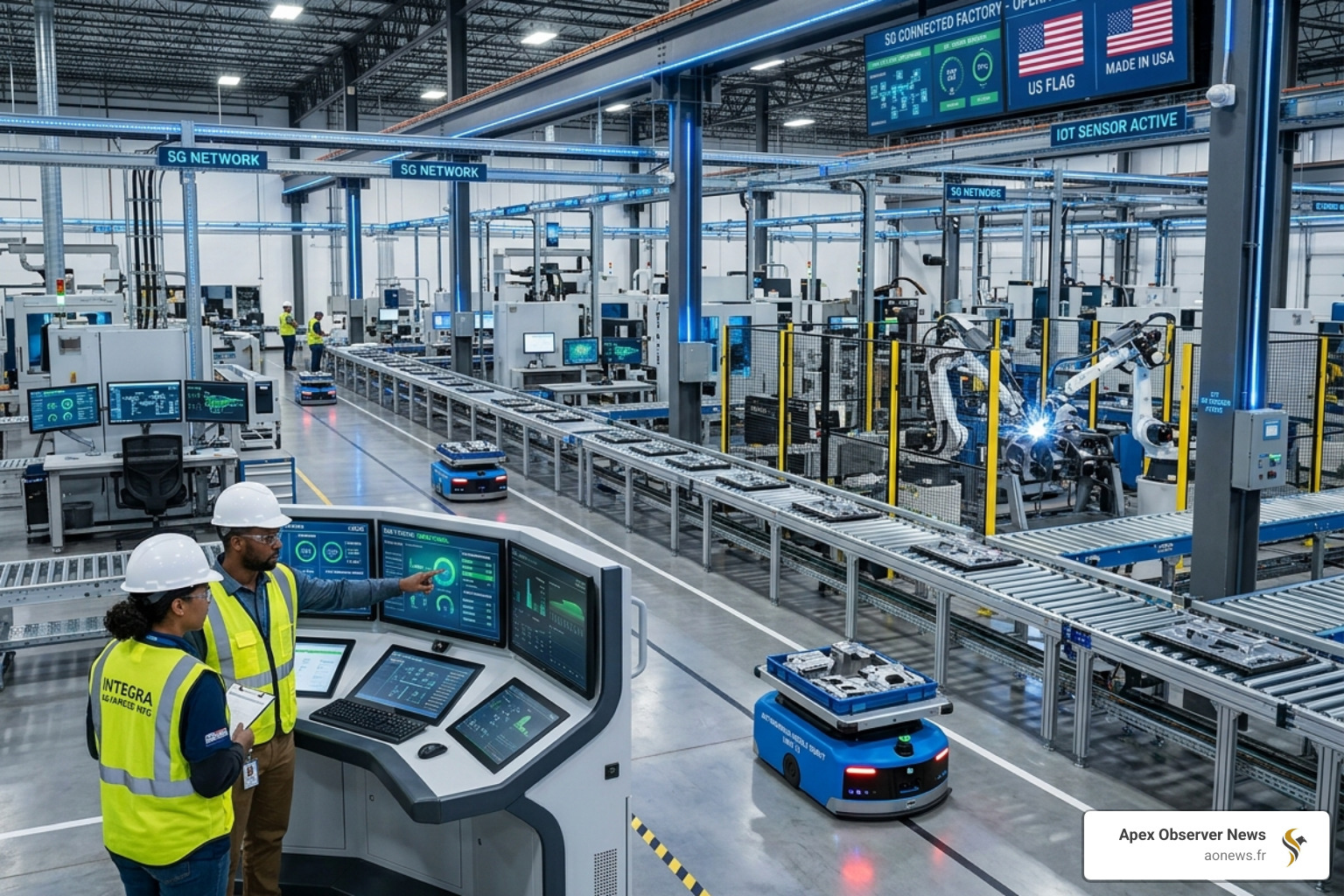
- Manufacturing: 20-30% productivity gains through “Industry 4.0” and autonomous robots.
- Retail: AR/VR “try-on” experiences that could boost sales by up to 50% by reducing returns.
These applications are often powered by Tag: mobile-apps that leverage 5G’s ultra-low latency (as low as 1ms) to perform tasks that were impossible on 4G.
The Critical Need for Mid-Band Spectrum
The math on spectrum is staggering. Each additional 100 MHz of mid-band spectrum allocated to mobile use is estimated to generate $264 billion of GDP and create 1.5 million new jobs.
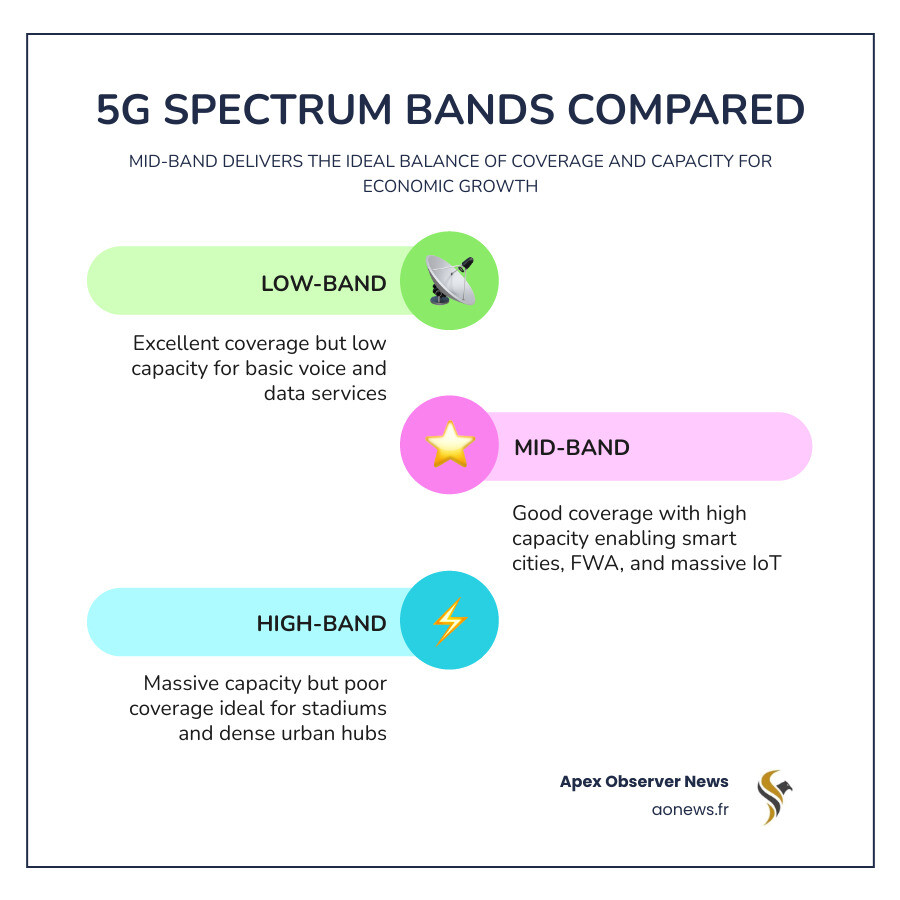
| Spectrum Band | Coverage | Capacity | Economic Primary Use |
|---|---|---|---|
| Low-Band | Excellent | Low | Basic Voice & Data |
| Mid-Band | Good | High | Smart Cities, FWA, IoT |
| High-Band | Poor | Massive | Stadiums, Dense Hubs |
Global Competition and the Risk of Falling Behind

There is a strategic risk here. The US currently has less mid-band spectrum available for 5G than international peers like China. Failing to harmonize our spectrum with global standards could turn the US into a “wireless technology island.”
Leading the adoption of internationally harmonized spectrum (like the 7/8 GHz bands) could unlock an additional $200 billion in US economic growth. It also ensures that our network equipment makers can compete globally against subsidized foreign vendors. This is particularly relevant as we look at the pricing of global hardware, such as Category: IT & Telecom / Mobile Prices / Samsung Prices, where economies of scale drive down costs for everyone.
Policy Recommendations for 2026 and Beyond
To ensure the 5G rollout economic boost doesn’t stall, proponents offer several key policy recommendations:
- Streamlined Permitting: State and local governments need to make it easier to install “small cells” on existing infrastructure.
- Talent Pipeline: We need to upskill the workforce. A 1% shortfall in 5G-related talent could cost the economy $20 billion.
- R&D Incentives: Providing subsidies for 5G pilot projects in manufacturing and healthcare to prove the Return on Investment (ROI).
Frequently Asked Questions about 5G Economic Impact
Has 5G actually increased US GDP as of 2026?
The answer is nuanced. While trillions are projected by 2030, current empirical data shows that the measurable impact on broad county-level GDP is still developing. We are seeing “micro-boosts” in specific sectors like Fixed Wireless Access and industrial IoT, but the massive “macro-boost” is likely still a few years away as applications scale.
Which industries have seen the largest 5G rollout economic boost?
So far, the Information Services and Manufacturing sectors have seen the most direct benefits from infrastructure spending and early automation. Healthcare is expected to be the biggest winner in the long term, particularly through remote patient monitoring and tele-surgery.
Why is mid-band spectrum considered the “Goldilocks” of 5G growth?
Mid-band is the only spectrum that offers the right balance. It can travel far enough to cover a neighborhood (unlike high-band) but carries enough data to support high-speed applications (unlike low-band). This makes it the essential ingredient for the 5G applications that actually drive business revenue.
Conclusion
Is 5G the economic savior it was promised to be? The reality in 2026 is that 5G is a long-term enabler rather than a magic wand. The 5G rollout economic boost is real, but it requires massive, ongoing investment in infrastructure and spectrum to reach its full potential.
While industry reports remain highly optimistic about the $1.7 trillion future, the evidence-based perspective reminds us that policy and execution matter more than hype. For the US to stay ahead, we must prioritize spectrum auctions, workforce training, and smart regulation.
At Apex Observer News, we’ll continue to track these developments as they happen. Whether it’s a new spectrum auction or a breakthrough in smart manufacturing, the 5G story is just getting started.


