
In the modern digital landscape, data is the new gold. From the simplest mobile app to the most complex global logistics network, everything runs on information. But this information needs a highly organized, reliable, and secure home. This is the domain of the SQL database—a fundamental technology that serves as the backbone for virtually every data-driven operation today.
While many people use the term “SQL database” almost interchangeably with “relational database,” it’s crucial to understand the distinct roles of the structure and the language. A SQL database is, at its core, a Relational Database Management System (RDBMS) that utilizes Structured Query Language (SQL) for data interaction. It’s not just a collection of files; it’s a sophisticated, architectural engine designed for stability, consistency, and efficient access to highly structured data.
The Foundation: Understanding the Relational Model
The concept that gives the SQL database its power is the relational model, first proposed by Edgar F. Codd in 1970. Imagine a traditional paper-based filing system, but with an unprecedented level of internal organization and cross-referencing capabilities.
Tables, Tuples, and Attributes
The building block of a SQL database is the table. Think of a table as a highly structured spreadsheet.
-
Rows (Records or Tuples): Each row represents a single, complete entity or record. For a customer database, one row would contain all the data for one customer: their ID, name, address, etc.
-
Columns (Fields or Attributes): Each column defines a specific type of information or attribute held by the entity. For the customer table, columns would be
CustomerID,FirstName,LastName, andEmail.
The Power of Relationships
What truly sets a relational database apart is its ability to define and maintain relationships between different tables. This avoids the problem of data redundancy and ensures data integrity.
Consider an e-commerce platform. You wouldn’t want to store a customer’s entire address and name in a separate Orders table every time they place an order. Instead, you create a dedicated Customers table and an Orders table. The Orders table simply includes a Foreign Key—a column (like CustomerID) that points back to the Primary Key (the unique identifier) in the Customers table. This link is the “relationship.“
This structure ensures:
-
Data Consistency: If a customer changes their address, you only update it in one place (the
Customerstable). -
Storage Efficiency: You don’t duplicate long strings of text (like addresses) across countless order records.
The Language of Interaction: Structured Query Language (SQL)
If the relational model is the architecture, SQL (Structured Query Language) is the universal language used to communicate with the database engine. SQL is an expressive, declarative language—you declare what you want to achieve, and the database engine figures out the most efficient how.
SQL commands are typically categorized into four main groups, providing the full spectrum of data management capabilities:
-
Data Definition Language (DDL): Used to define or modify the database structure (schema).
-
CREATE TABLE,ALTER TABLE,DROP TABLE.
-
-
Data Manipulation Language (DML): Used to manipulate the data within the tables.
-
SELECT(for querying/retrieval),INSERT,UPDATE,DELETE.
-
-
Data Control Language (DCL): Used to control access permissions and security.
-
GRANT,REVOKE.
-
-
Transaction Control Language (TCL): Used to manage the effective execution of database transactions.
-
COMMIT,ROLLBACK.
-
The SELECT statement is arguably the most common and powerful DML command, allowing users to retrieve complex, filtered, and aggregated data from single or multiple joined tables—the core function of a database.
The Inner Workings: How the SQL Database Engine Executes a Query
The magic of a SQL database happens under the hood within the Database Management System (DBMS), often referred to as the Database Engine or Storage Engine. When a user or application submits an SQL query, it goes through a complex, multi-stage pipeline.
1. The Parser and Validator
The moment an SQL query is received, the system’s Parser takes over. It breaks down the query string into smaller, meaningful components called tokens. It then checks the syntax to ensure the command follows all the rules of the SQL language. Following a successful parse, the Validator or Semantic Checker ensures the command makes logical sense in the context of the database’s schema. Does the requested table actually exist? Does the user have permission to run this query? Are the columns spelled correctly? If any structural or authorization error is found, the query is rejected.
2. The Query Optimizer: The Database’s Architect
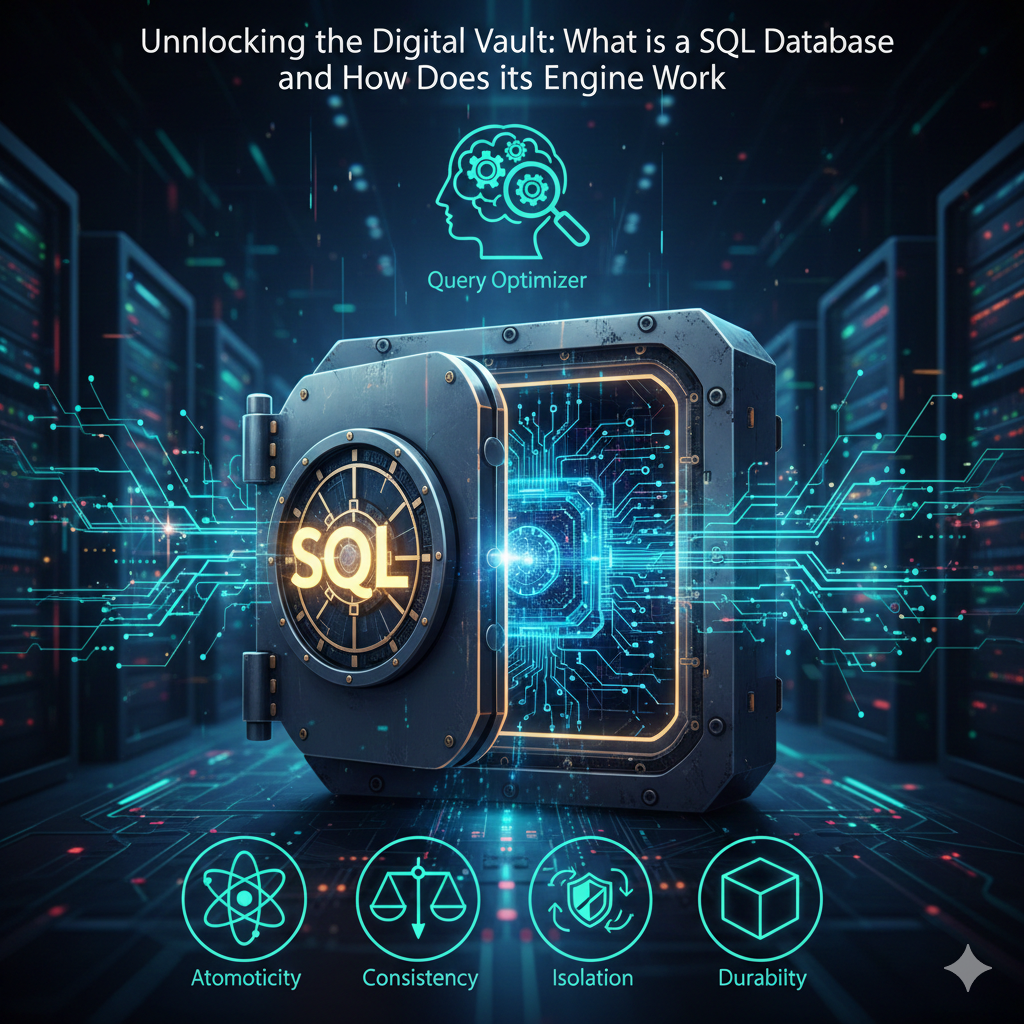
This is arguably the most fascinating part of the process and a key differentiator between high-quality DBMS platforms. The Query Optimizer takes the validated SQL statement and determines the most efficient execution plan.
A simple SELECT statement might have a hundred different ways to fetch the required data. Should the system scan the entire table? Should it use a specific index (a special, pre-sorted lookup structure, like the index in a book) on one of the columns? Which tables should be joined first? The optimizer uses statistical information about the data (such as the number of rows or the distribution of values) to calculate the cost (in terms of I/O operations and CPU usage) of various possible plans and selects the one estimated to be the fastest. A poorly optimized query can take hours; an efficiently optimized one takes milliseconds.
3. The Relational and Storage Engines
The chosen execution plan (often in an intermediate form like bytecode) is passed to the Relational Engine (or Query Processor), which is responsible for coordinating the steps of the plan. This engine interacts directly with the Storage Engine, the component that actually manages the physical data files on the disk. The Storage Engine is the low-level data handler, responsible for:
-
Reading and writing data blocks from the hard disk.
-
Managing memory buffers (caches) to hold frequently accessed data.
-
Ensuring the fundamental Atomicity, Consistency, Isolation, and Durability (ACID) properties of transactions.
4. ACID: The Guarantor of Integrity
The ACID properties are the sacred contract of relational databases, ensuring that data remains reliable, especially during concurrent operations or system failures.
-
Atomicity: Ensures that a transaction is an “all or nothing” proposition. Either all operations within a transaction succeed, or the entire transaction is rolled back.
-
Consistency: Guarantees that a transaction only moves the database from one valid state to another, always preserving defined rules and constraints.
-
Isolation: Ensures that concurrent transactions do not interfere with each other, meaning that the result of transactions processed at the same time is the same as if they were executed sequentially.
-
Durability: Guarantees that once a transaction is successfully committed, its changes are permanently stored and will survive any subsequent system power loss or crash.
Scaling, Types, and the Future Landscape
While the core principles remain the same, modern SQL databases have evolved significantly to meet the demands of massive data volumes and high-traffic applications.
Vertical vs. Horizontal Scaling
Traditional RDBMS platforms are often associated with Vertical Scaling (scaling up), meaning you increase capacity by adding more resources (CPU, RAM, faster disk drives) to a single server. This is efficient but eventually hits a physical limit.
The emergence of cloud-native and distributed SQL solutions (often called NewSQL) has introduced a form of Horizontal Scaling (scaling out), allowing the data to be spread across many commodity servers. This offers near-limitless capacity and high availability, merging the consistency of SQL with the scale previously only associated with NoSQL databases.
Key Players in the RDBMS World
The core relational model is implemented by various powerful software products, each with its own features and ecosystem:
-
Open Source: MySQL and PostgreSQL are extremely popular, with PostgreSQL, in particular, being renowned for its high adherence to standards and advanced features.
-
Proprietary/Enterprise: Microsoft SQL Server, Oracle Database, and IBM Db2 dominate the enterprise market, offering advanced features, complex licensing, and dedicated support.
Final Thoughts: The Unseen Foundation
The SQL database is far more than just a collection of tables; it is a meticulously engineered system designed to be the single source of truth for an application’s data. Its reliance on the relational model, the expressive power of SQL, and the rigor of the ACID properties makes it an indispensable tool for managing structured data that requires reliability, integrity, and complex querying. As data continues to explode in volume, the underlying principles of the SQL database remain the bedrock of consistent and trustworthy information management across the globe.
Focus Keyword: SQL Database Title: Unlocking the Digital Vault: What is a SQL Database and How Does its Engine Work?Meta Description: Explore the architecture and function of a SQL database. Learn how the relational model, Structured Query Language (SQL), and the ACID properties work together to ensure efficient, reliable, and secure data management.
This video provides an excellent visual introduction to the foundational concepts of databases, which are central to understanding the working of a SQL database.
Introduction to SQL – How SQL Works? – SQL Tutorial #1 – YouTube